What?
In the Winter of 2025 I was a student for a Product Design Course conducted Online. The visioning team is an internal consulting group made up of designers, researchers/strategists, and project managers who work in different companies to craft a future vision for young designers.
Contributions
As a designer, I researched agricultural pain points, designed the core user interface and typography scales, and specified responsive components to create an accessible, user-friendly platform.
Leadership
I collaborated closely with the team to align our design vision, iterate on component hierarchies, and refine the user experience for the platform.
"This overview highlights the core objectives and outcomes of the project. For a deep dive into the research methodology and technical specifications, please feel free to get in touch."
APPROACH
When we began, we did not immediately set out to build an agriculture platform.
Instead, we began with a broad exploration of problem spaces where design and technology could make a meaningful impact.
As we explored AgriTech more deeply, the problem stopped being abstract.
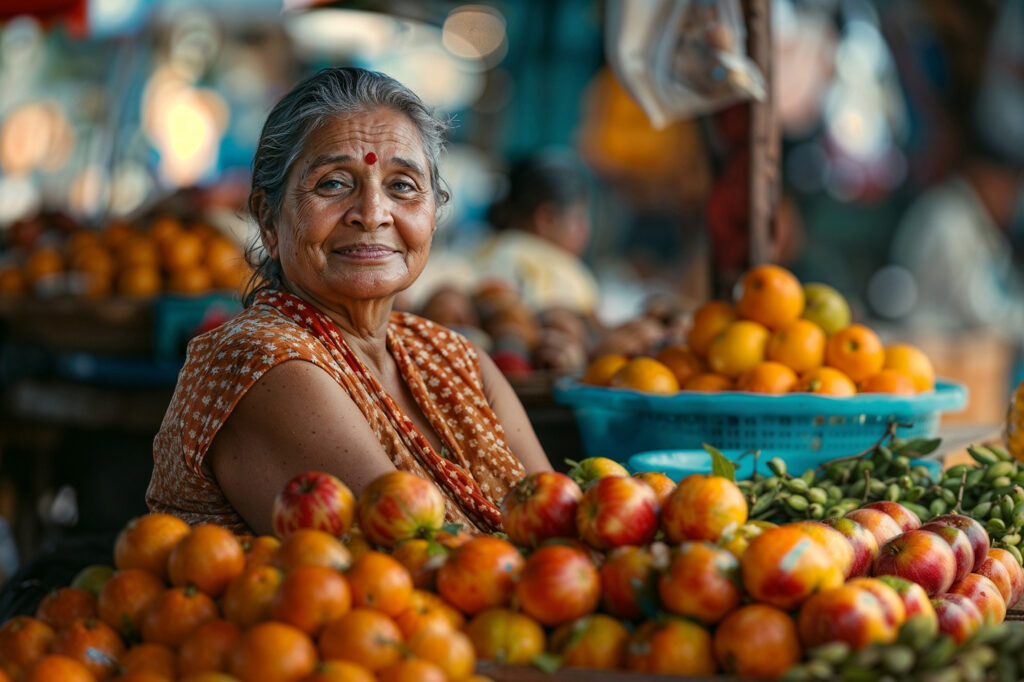
Small and marginal farmers lose nearly 15–20% of their income every harvest, not due to poor farming — but due to lack of access:
- To transparent markets
- To fair pricing
- To reliable, local-language information
- To direct connections with buyers
We realized that this wasn’t just an economic problem — it was a systemicandemotional one.
The people who feed the nation were the ones most excluded from the systems meant to
support them.
That contradiction stayed with us.
This realization marked a shift for us — from exploring problems to committing to one.
And that is how the journey toward FARM-E began.
Not as a product.
Not as a feature list.
But as a responsibility.
RESEARCH
Choosing to work on FARM-E was not only a strategic or academic decision — it was an ethical one.
The Visible Problems (Symptoms)
- Digital literacy gap — many farmers are unfamiliar with smartphones, apps, and interfaces.
- Lack of transparent market access — farmers often do not know the real-time prices, buyer demand, or fair value of their produce.
- Dependence on intermediaries — middlemen control information, pricing, and access to markets.
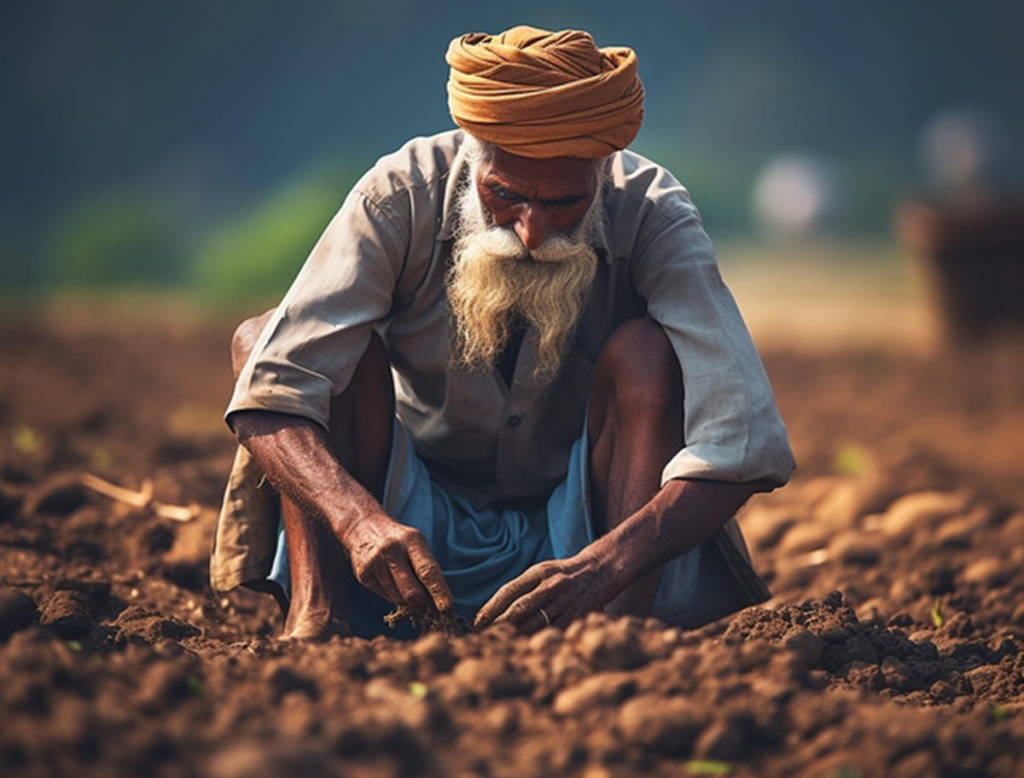
The Deeper Struggle (Root Problem)
As we reflected further, we realised the core issue was not technological — it was systemic and
human.
Farmers are not simply “behind” in adopting technology.
They are actively excluded from systems that are designed without their realities, contexts, and
constraints in mind.
The deeper challenges are:
Mismatch Between Digital Systems and Rural Reality
Most digital platforms assume:
● Stable internet connectivity
● High literacy (text-heavy interfaces)
● Familiarity with digital navigation
● Time availability to explore and learn tools
Power Asymmetry in the Supply Chain
Farmers operate in a system where:
● Buyers have more information than sellers,
● Prices are often decided before farmers even reach the market,
● And transparency is intentionally or structurally limited.
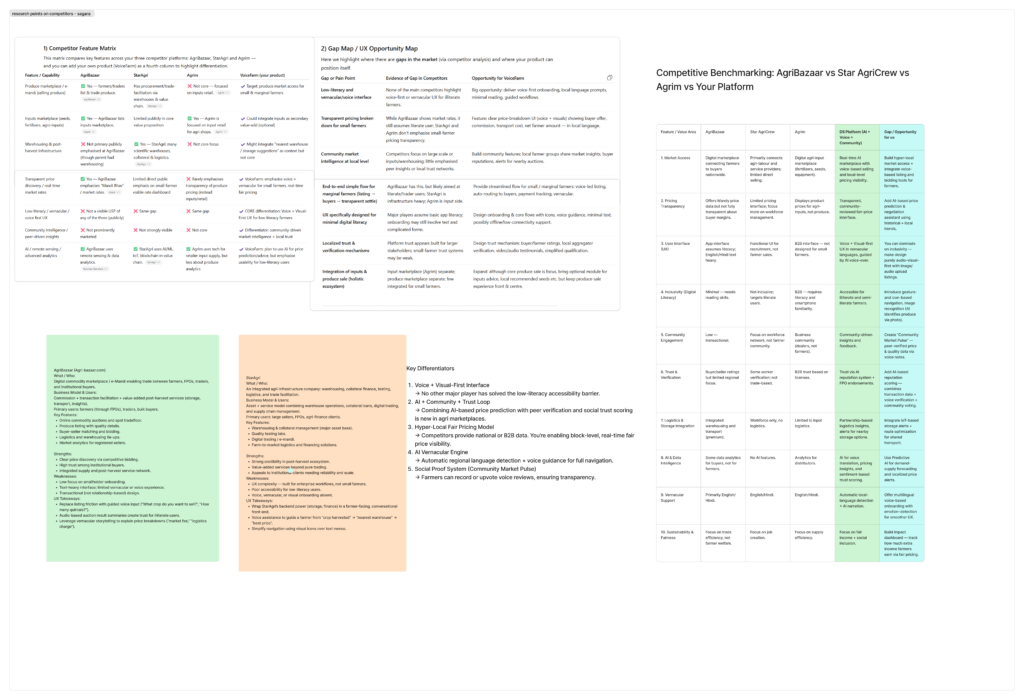
We approached research in two complementary ways:
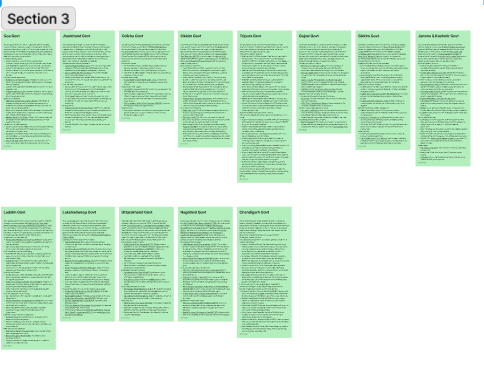
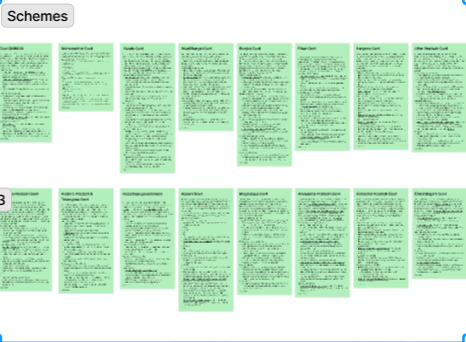
● Online / Secondary Research — to understand macro-level patterns, policies, and systemic failures.
● Field / Primary Research — to understand lived experiences, behaviors, emotions, and constraints.
IDEATION
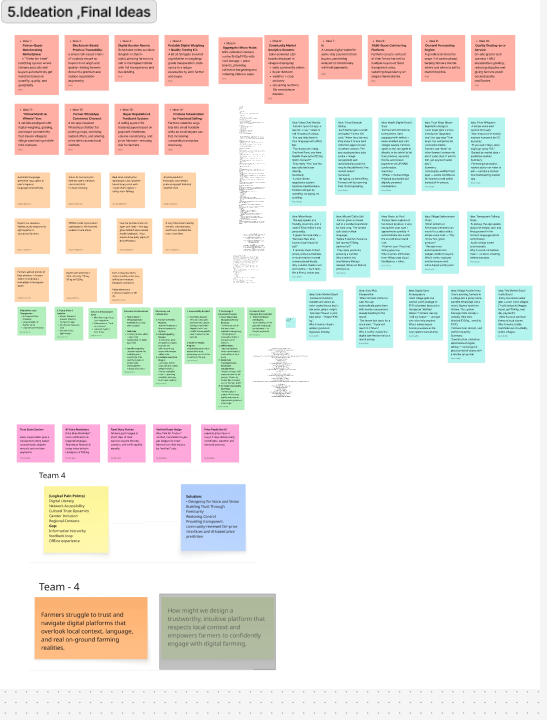
We approached ideation with three guiding principles:
Accessibility before innovation If a solution is powerful but inaccessible, it is ineffective. We prioritised ideas that could reach farmers regardless of literacy, language, age, or device type.
Trust before adoption Farmers will not adopt something they do not trust. Familiar mediums, human touchpoints, and local language were considered as important as technology itself.
Dignity before efficiency We wanted farmers to feel empowered — not managed, monitored, or controlled.
Primary Ideas
AI Voice Assistant
Sky Radio
IVR (Interactive Voice Response)
Secondary Ideas
Kiosks (Digital Service Hubs)
Social Media Integration
The outcome of ideation was not a feature list. It was a philosophy:
Access is a right, not a privilege.
Technology must adapt to people — not the other way around.
FARM-E is designed to restore agency, rebuild trust, and bring farmers into the digital ecosystem without forcing them to change who they are.
USER FLOW
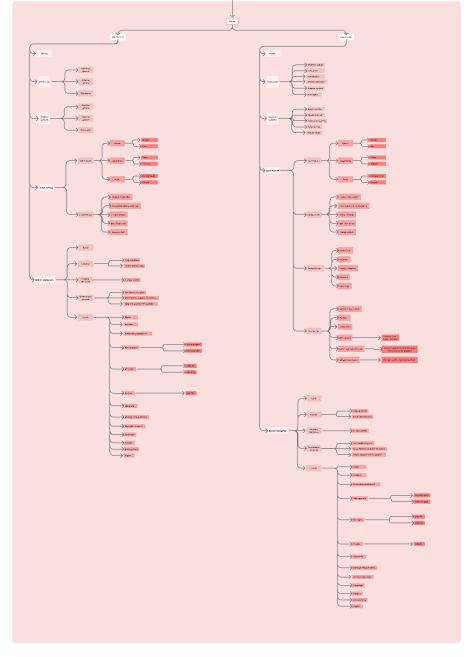
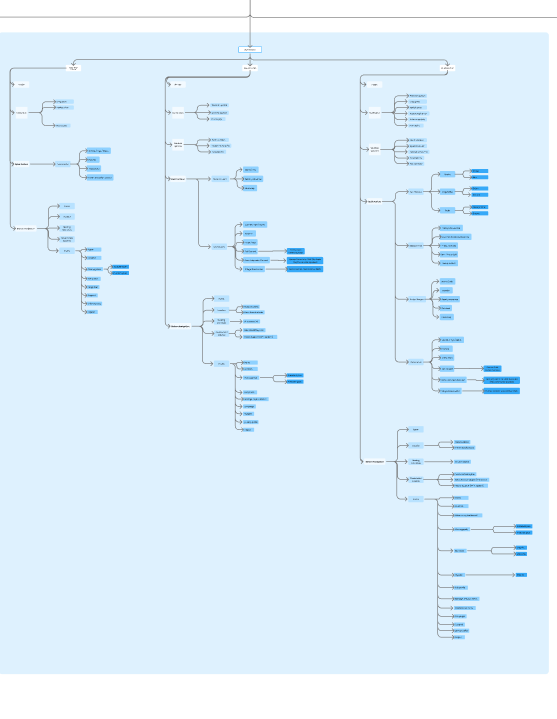
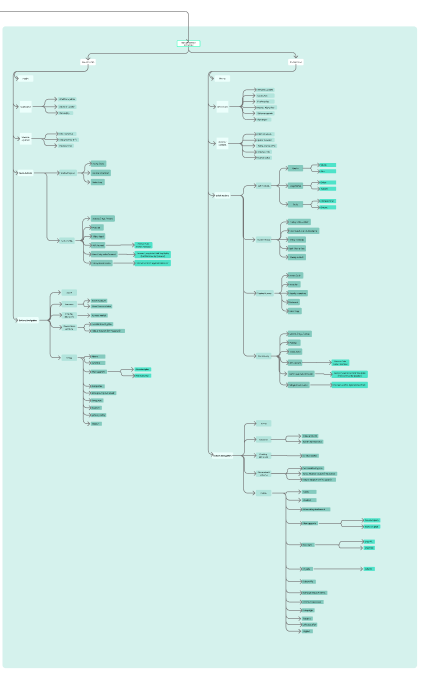
What made FARM-E fundamentally different from other agri-platforms is that it is not designed for one user type — it is designed as an ecosystem of users who together shape fairer market access, better information flow, and stronger trust.
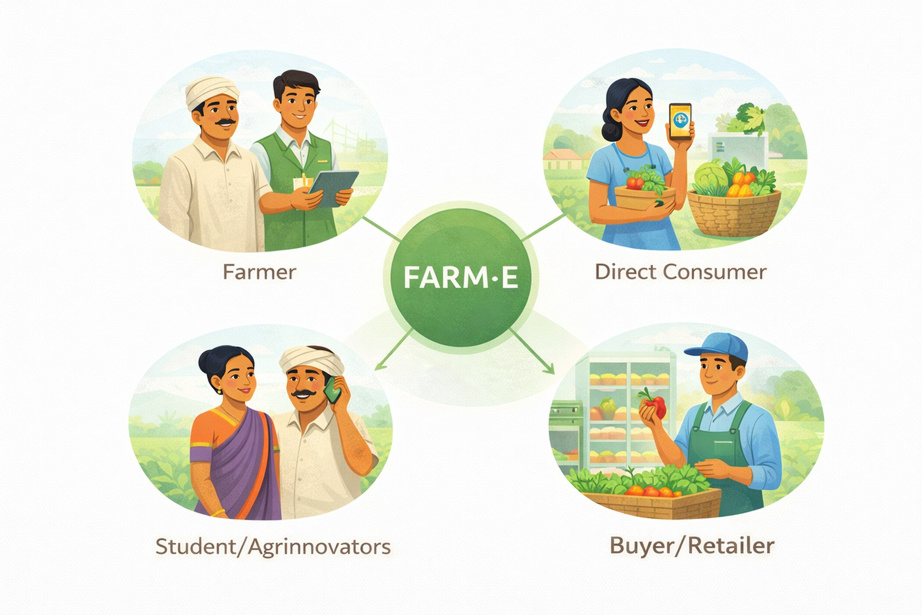
Instead of building only for farmers, we intentionally included :
- Farmers
- Buyers / Retailers
- Direct Consumers
- Students
- Agricultural Innovators / Experts
This decision was not technical — it was ethical and systemic. Because the farmer’s problems do not exist in isolation.
They are created by broken relationships between producers, markets, consumers, institutions,
and knowledge systems. By including all relevant actors into one connected platform, we aimed to:
● Reduce information asymmetry
● Increase transparency
● Redistribute agency
● And rebuild trust across the agricultural value chain.
LOGO — MEANING AND IDENTITY
Why the Logo Matters
The FARM-E logo is not just a visual mark — it is a symbol of intent. It represents the platform’s
core purpose: to bridge the structural gap of access, information, and opportunity in Indian
agriculture.
Small and marginal farmers lose nearly 15–20% of their income every harvest due to opaque
pricing, dependence on intermediaries, and exclusion from digital systems. The logo therefore
becomes a signal of inclusion — a promise that technology can be built with farmers, not just for
them.
It stands for:
● Access instead of exclusion
● Growth instead of stagnation
● Trust instead of complexity
● Human presence instead of abstract technology
DESIGN SYSTEM
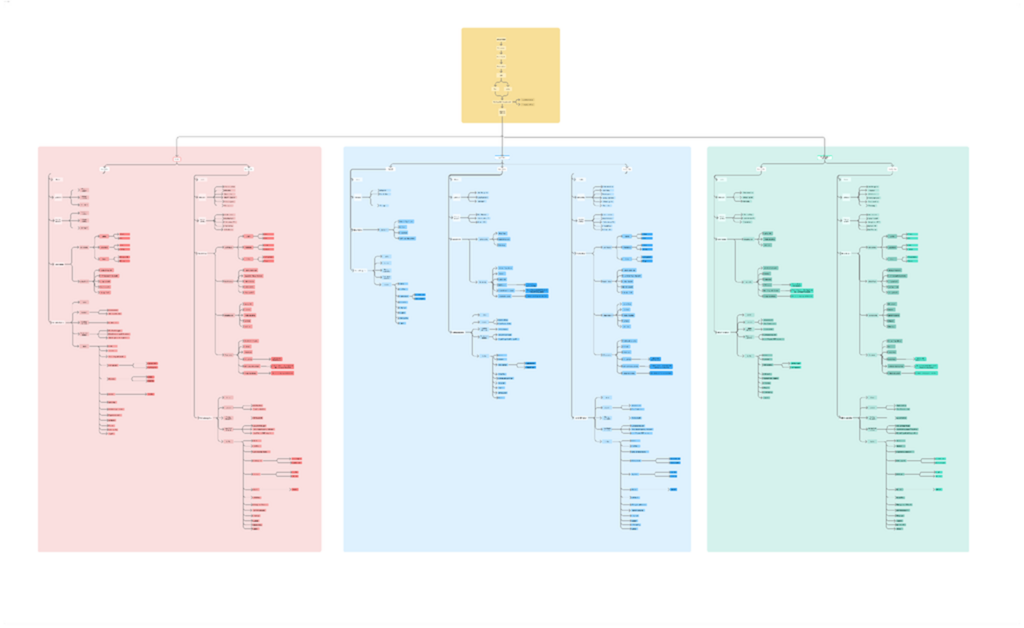
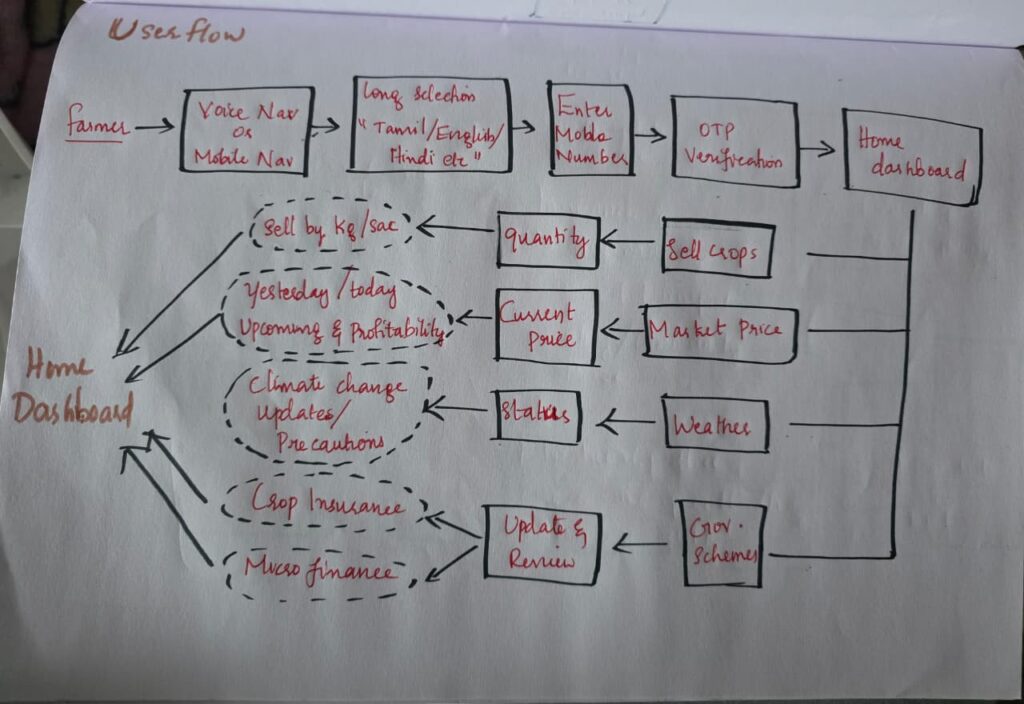
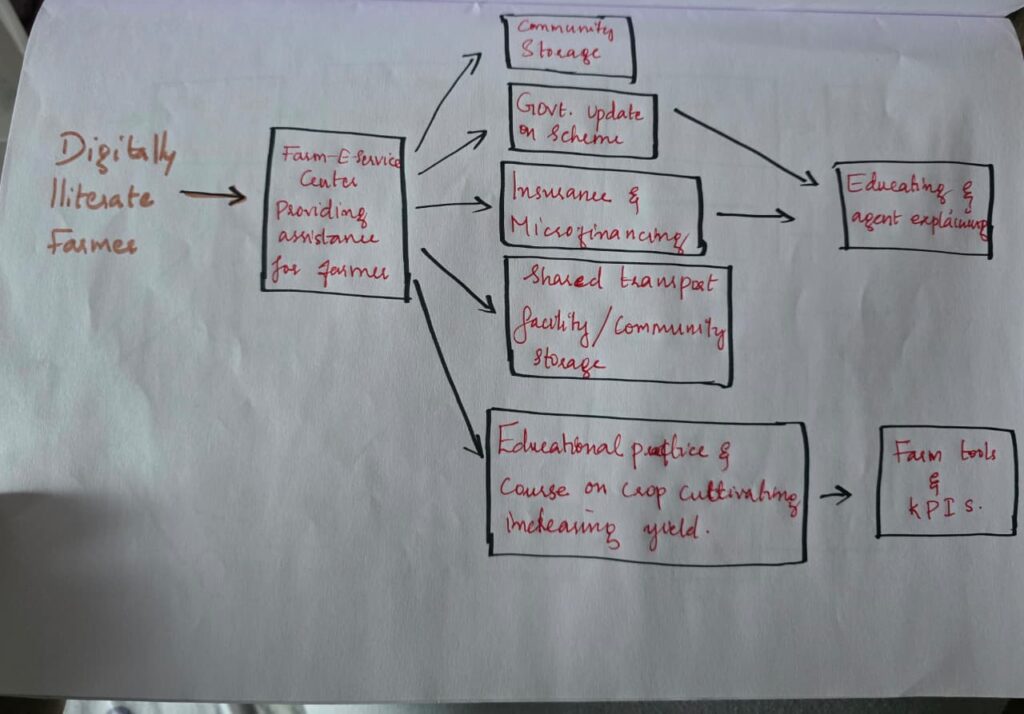
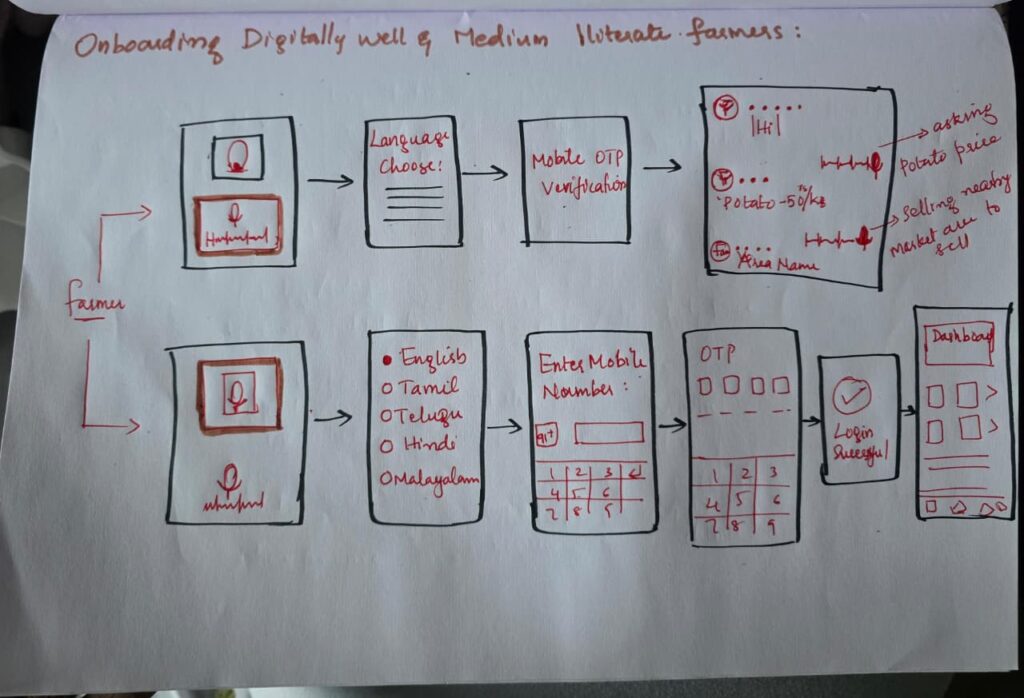
We began with paper sketch wireframes to explore ideas quickly and freely. Sketching allowed us to experiment with multiple layouts, flows, and content groupings without constraints. It helped the team align on:
● What information should appear first for each user type
● How key actions like “Check Price”, “Sell Produce”, or “Get Updates” should be positioned
● How complex systems could be simplified into linear, understandable steps
Once the structure felt right, we translated these sketches into low-fidelity digital wireframes. This step helped us standardise layouts, define screen-to-screen flow, and test usability at a systemlevel.

HIGH FIDELITY SCREENS
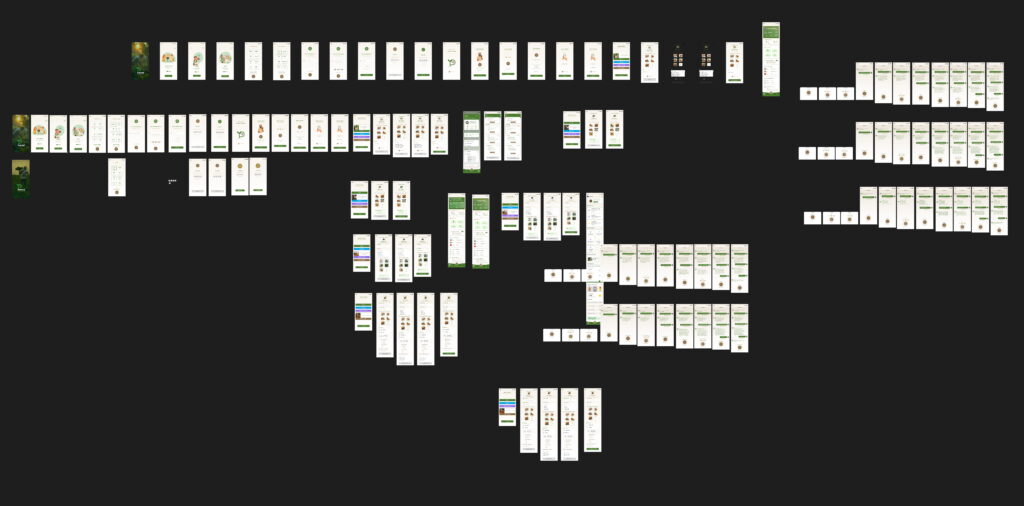
The final UI reflects the true purpose of the platform:
to create a transparent, inclusive, and emotionally safe digital space where farmers are not users — they are partners.
By designing four connected experiences around farmers, we created a system that:
- Shares power instead of concentrating it
- Builds trust instead of extracting value
- Creates learning instead of just transactions
This is not just an interface. It is a new kind of agricultural infrastructure — designed with empathy, built for equity, and grounded in reality
PROTOTYPING — FROM STRUCTURE TO EXPERIENCE
We focused on high-impact flows instead of every edge case:
● Farmer onboarding and first listing
● Voice-based market query
● Buyer discovering and connecting with farmers
● Consumer browsing and trust signals
● Student/innovator publishing and sharing insights
These flows represented the emotional and functional core of the system.